Over the last two weeks, I have analyzed my own e-mail inbox to understand what makes e-mail marketing successful. I received 88 promotional emails from various companies, and by examining both successful emails and those that landed in my spam folder I have discovered valuable lessons about e-mail marketing practices. First let’s go over the basics of e-mail marketing, then we will go into detail about what I learned from receiving these emails.
Why is Email Marketing Still Important?
Email Marketing is CHEAP and EFFECTIVE
E-mail marketing continues to be one of the most cost-effective marketing channels available. Unlike social media platforms where you are often renting space and paying to reach your audience, e-mail marketing provides your business with “owned” media. Your e-mail list belongs to you, and you don’t have to pay anyone to reach this audience. The average return on ads spent on e-mail marketing campaigns is an impressive 36 dollars. This means for every dollar you invest in e-mail marketing; you will receive $36 back. This ratio is great for ROI; it makes e-mail marketing one of the most profitable digital marketing channels available.
E-mail is also one of the universal platforms that creates a bridge among age barriers. Whether you are 14 living in America or 70 living in Germany, you will have an e-mail address. E-mail addresses have become universal access codes for the Internet. Do you want to sign up for social media? You need an e-mail address. Do you want to make a purchase online? You will need an e-mail address. Do you want to receive a recipe or download content? You will need an e-mail address. This exchange of goods for an e-mail address creates a valuable cycle where customers are willing to provide their e-mail addresses in return for something that they want, where businesses offer value in exchange for this access.
SPAM
Although e-mail marketing is extremely effective, it has not always had such a great reputation. Early e-mail marketers created SPAM messages that were distributed to thousands of people simultaneously as top of funnel content. This mass amounts of impersonal emails gave the entire industry a bad reputation that it is still working to overcome, and many people still see e-mail marketing as a less effective digital marketing tool.
In response to this activity from the early marketers, the CAN-SPAM law was passed in 2003. This legislation established important guidelines for e-mail marketers, such as no false or deceptive headlines can be included in subject lines of emails, all emails must include the senders postal address, messages must clearly identify themselves as advertisements, go fishing for personal information, and every e-mail must include a working “unsubscribe” link. Although not every promotional email nowadays perfectly follows CAN-SPAM guidelines and enforcement isn’t the strictest, the law did legitimize email marketing and rebuild its reputation as a credible marketing channel.
What Skills Must an Email Marketer Have?
Building a List
Successful e-mail marketing occurs from a business actually building an email “list” of people who want to receive your promotional emails. If you take shortcuts (such as buying an e-mail list) your messages will most likely end up in spam folders. E-mail platforms use sophisticated algorithms to decide what content users want to see, and they will hide content that doesn’t match user’s preferences.
Building a quality list starts with people who genuinely want to hear from you regularly and are interested in what you have to say. The main idea is that creating incentives is crucial, and offering customers something valuable for signing up such as free items on their birthday or monthly discounts will create this incentive for the customers.
Website sign up forms are essential tools for e-mail marketers. When someone visits your website for the first time, they are in the awareness stage of the buyer’s journey. By encouraging an e-mail sign up during the awareness stage increases the likelihood that they’ll return to your website later. Adding a sign-up button to your emails themselves makes it easier for satisfied subscribers of your e-mail to forward your content to their friends so they can easily add themselves to their list.
Free events such as web seminars provide excellent opportunities to collect e-mail addresses. The kind of people who attend these events have already demonstrated interest in your products and services, which makes them great a fit for your e-mail list.
Segmentation of List:
While building your list is important, this is only the first step. Although everyone on your list wants to hear from you, they do not want to hear the same thing, so we must segment our list. Different customers want different products, hold different roles in their companies, or even exist at different stages of the buyer’s journey. Successful e-mail marketing requires sending targeted emails to people with specific needs.
This is where RFM analysis becomes valuable. RFM stands for recency, frequency, and monetary value. By connecting your e-mail list to your customer database, you can identify which customers purchase most recently, which customers purchase most frequently, in which customers spend the most money either per transaction or overtime. Using RFM analysis will cause an increase in conversion rates, while simultaneously making these conversions more valuable for our business.
When looking at my own inbox, I noticed some distinct factors in each email. I took notice about how often these businesses are sending me promotional emails. I found that the frequency of these businesses sending me these emails is not random. The business has analyzed my engagement in purchasing behavior to find out the best time in frequency to send me these emails.
Creating Effective Emails
First, let’s talk about the e-mail length. E-mail length depends on your goal of the message. Newsletter e-mails are longer for people in consideration and decision stages, while lead generation emails will be short, visually appealing, and easy to read for the awareness stage. Since most people read emails on their mobile devices, you must make your emails design mobile friendly. If you want to increase web traffic, include only partial information in the e-mail to encourage click-throughs onto our website.
Personalization has a huge impact on performance of your emails. Use actual names like max@yourcompany.com instead of generic addresses like newsletter@yourcompany.com. You can also pull customer names from your database to personalized greetings for your emails. Both tactics increase open rates and reduce spam filtering. Your subject lines of your e-mail should also be eye grabbing and use the word “you” to create a connection/reason to buy your product or service.
You should also include actionable language in call-to-action (CTA) buttons. This can look like subject lines with phrases like, “Get your recipe”, “Start your trial now”, and “Reserve your room today”. Make sure you only use one CTA button per e-mail, as too many offers confuse readers. Try to focus on benefits for the readers, and not just list the product features you offer.
For deliverability, invest in e-mail marketing software such as Constant Contact or MailChimp to avoid spam filters. Encourage recipients to add your address to approve sender list, and avoid spammy keywords like “free”, “guarantee”, and “credit card”.
While all these tactics are great practices, measuring your results of your e-mail marketing campaigns is essential. You can track delivery statistics including bounce rate, hard bounces (invalid email addresses), and soft bounces (temporary internet issues). You should also monitor response rates such as open rate, click-through rate, and opt-out rate (unsubscribe). High opt out rates mean there are problems in your e-mail marketing campaign that must be fixed immediately. You can improve these results by experimenting with e-mail frequency, increasing e-mail personalization, and changing sender addresses in subject lines.
Key Features of Email Marketing Software
Automation
Modern e-mail marketing does not involve people manually sending messages one by one. E-mail marketing software allows e-mail marketers to implement sophisticated email automation. Features such as customer journey mapping helps sort customers by their position in the buyer’s journey, and with customers in the consideration and decision stages that require different content to drive conversions.
E-mail software automatically handles this segmentation. For example, if a customer downloads some content off a website, the system will automatically send the customer a follow up e-mail 48 hours later. If someone adds an item to their cart but doesn’t complete the purchase, the system will automatically send the customer a follow-up e-mail with a coupon prompting them to buy the product. Companies can even send out birthday emails to go out automatically with appreciation messages and special offers.
The marketers who create these automation workflows are extremely valuable because the more personalized an ad feels, the higher the open rate will be. E-mail marketing software makes this automation easy to create and maintain and allows for complicated personalization emails at large scales.
AB Testing
Next, let’s discuss how e-mail marketing software makes AB Testing straightforward and actionable. The typical AB testing process involves sending 2 versions of an e-mail to a certain percentage of your list (let’s say 40%), Then sending each version to half of the percent of your list (in this case Version 1 goes out to 20%, and Version 2 goes out to 20%). After, you select a specific metric to track such as open rate or click through rate. You then run the test to see which e-mail performs better based on that certain metric. The remaining portion of your list (in this case 60%) will receive whichever version of the e-mail performed better.
AB testing can be applied to numerous variables in e-mail marketing. Subject lines are of course the obvious option for testing. Send time should also be AB tested, and you should think about whether you should send your emails at 8:00 in the morning or 6 at night. For abandoned cart emails, you can test the content tone (sad vs. funny), and timing (an hour, day, week) after cart abandonment. Each AB test should provide data about what actually drives better conversions rather than relying on assumptions.
Analytics
Finally, we have e-mail marketing analytics. As e-mail marketers we must understand how our campaigns create web traffic. Real insights come from tracking how individual emails perform based on response rates statistics. You must monitor open rates, unsubscribe rates, and bounce rates to improve your next campaign.
Critical and effective analysis of email analytics requires data segmentation. You should examine whether open rates are different between devices, or whether click through rates vary between Gmail and Outlook users. You can also use heat maps to reveal which parts of your e-mail recipients look at the most frequently, and this will allow you to make an informed design decision for your emails in the future.
What a Good Promotional Email Looks Like
To understand what makes e-mail marketing successful, I analyzed my inbox over two weeks and received 88 promotional emails for multiple companies. One Progressive Insurance e-mail particularly demonstrated good e-mail marketing practices. After I clicked the main call to action button, the URL of the website contained this tracking code: utm_source=progressive&utm_medium=email&utm_campaign=Strategy_Device_Insurance The UTM source tells Progressive’s email analytics software exactly how I reached their web page, which was through their promotional e-mail. This tracking allows Progressive to measure not just overall campaign success but also the performance of each e-mail they have sent.
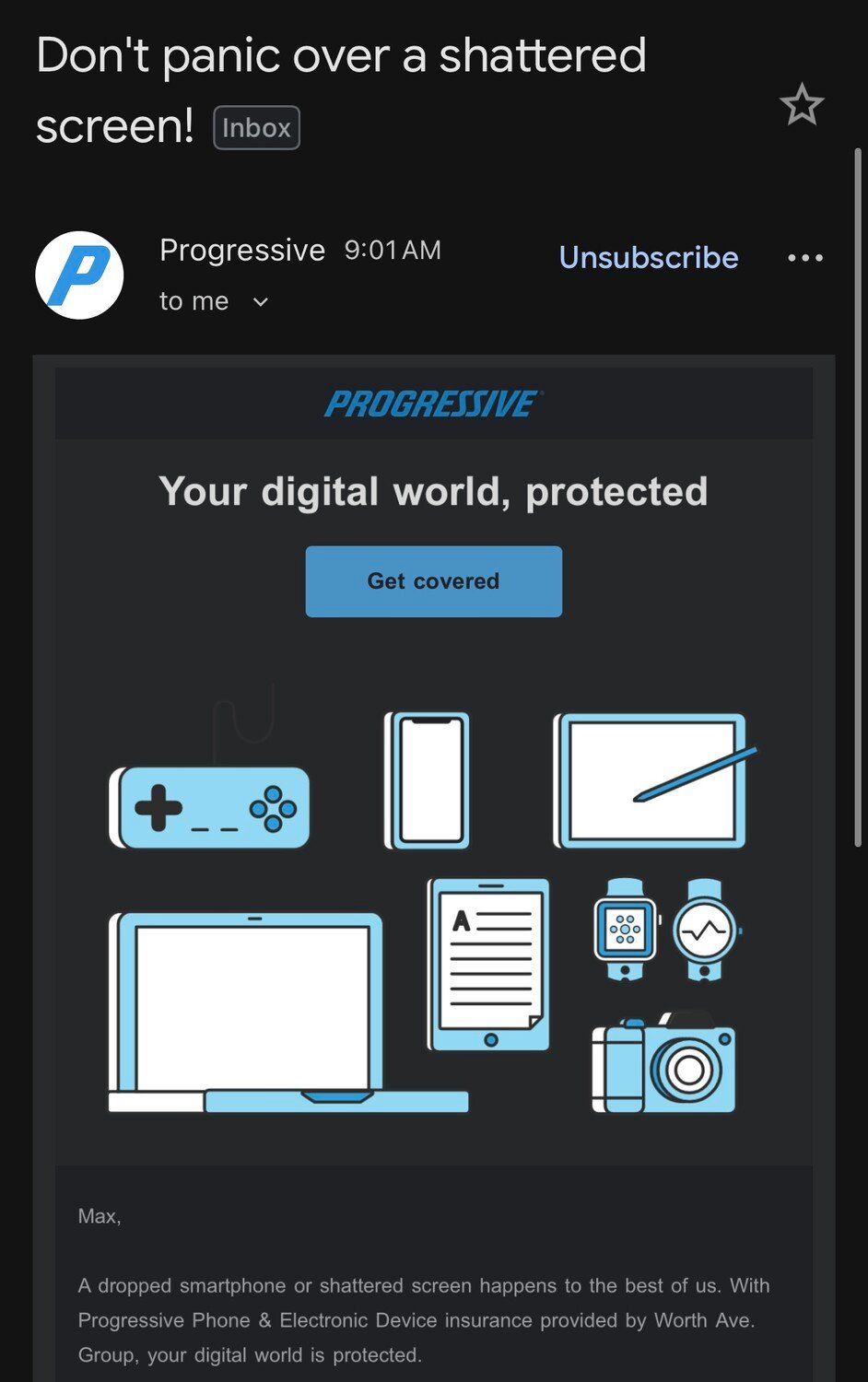
Some other good practices Progressive demonstrated in this e-mail was the e-mail subject line was principal and addressed a common problem, which is breaking phone screens. It avoided spam indicating keywords while creating an important connection to a problem in our society. More importantly, it included a working “unsubscribe” button and complies with CAN-SPAM requirements and demonstrates respect for the recipients’ preferences.
I noticed that these successful emails that ended up in my personal e-mail inbox shared common characteristics. They all use personalized sender addresses rather than generic ones like sales@company.com. They all pulled customer names from databases to give personalized greetings that says, “Hi Max…”, and they are also all used actionable language in their call-to-action buttons such as “get covered”. Each e-mail also focused on a single and clear call to action button to avoid confused readers with multiple offers.
What SPAM Emails Look Like
Moving on, let’s talk about what an e-mail that ends up in spam looks like. One example of an e-mail that ended up in my spam was from the business, “GermanFoods”.
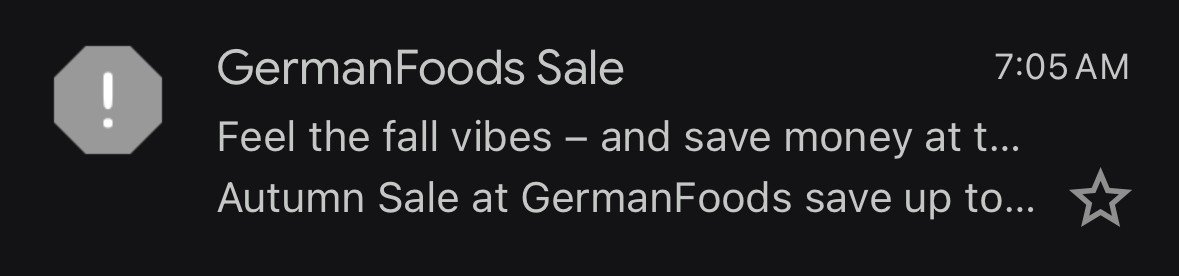
The subject line “save money at the same time” contained keywords that trigger spam filters. E-mail platforms have created an algorithm to filter messages with spammy sounding phrases like “free”, “guarantee”, “credit card”, and other variations of “save money”. A better approach would be testing different subject lines keywords that convey value without triggering spam filters.
Next, the sender’s address newsletter@sinho.de is generic and impersonal, making it obvious that the e-mail was sent as mass promotional content. Using an actual person’s name like “Joram@sinho.de” would make the email appear more personalized, which will reduce the likelihood of spam filtering while increasing open rates.
All these failures connect back to the lessons about e-mail deliverability. If this brand invests in professional e-mail marketing software (such as MailChimp) to help assess campaign success, the emails they make will be less likely to be marked as spam. They should also encourage recipients to add your sender address to their approved sender list to further improve deliverability. Understanding what triggers spam filters (and avoiding these triggers) is essential for ensuring your emails reach their intended audience.
Wrapping Up
E-mail marketing works at every stage of the buyer’s journey and throughout the marketing funnel. It encourages both engagement and conversions while delivering the best ROI out of any marketing tool available. E-mail marketing is a great investment and should not be underestimated.
One important lesson is that we should always build our own list from people who want to hear from us. When someone clicks unsubscribe, we must remove them from our list as quickly as we can to ensure respect for our customers. We must segment our list appropriately to make emails as personal as possible, which allows you to capture customers at different stages of the buyer’s journey.
Let’s not forget to take full advantage of e-mail analytics. We should be AB testing as much as possible, and should test our subject lines, send times, content approaches, and call to action placement throughout our e-mail. By optimizing our marketing efforts with efficiency, using automation in software to handle repetitive tasks will allow you to focus on important things like strategy in creativity when crafting your emails for promotion.
By researching which companies successfully reached my inboxes and looking to see what practices they used when crafting promotional e-mail taught me that these companies build legitimate lists, they segment their lists thoughtfully, create emails carefully, measure their analytics with purpose, and use e-mail marketing software to automate their emails effectively. All our e-mail inboxes are filled with examples of what works and what does not, pay attention next time you browse through your e-mail inbox to see what content actually made it to your primary e-mail.