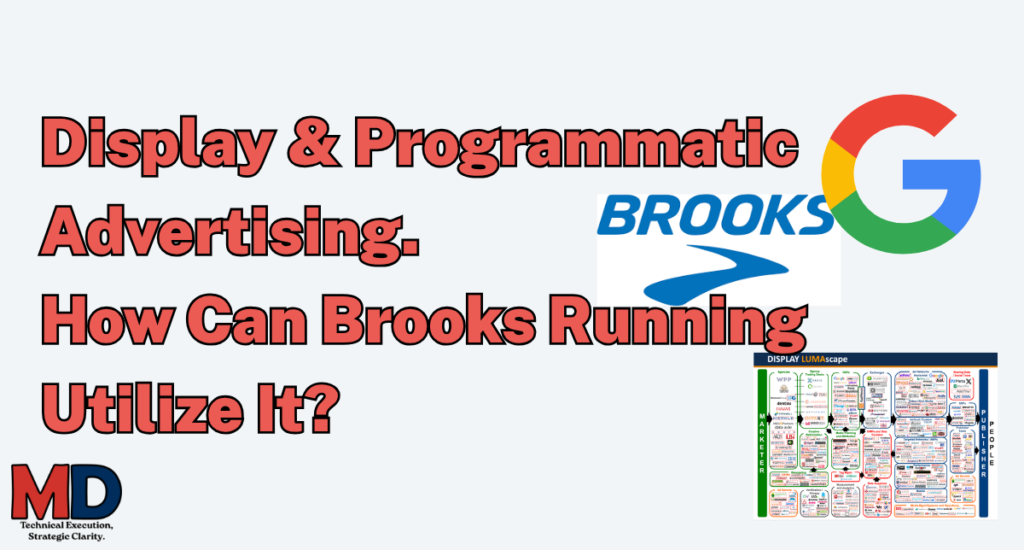
Display & Programmatic Advertising: How Brooks Running Can Utilize It
What is Display Advertising
Main Purpose
Display advertising is about delivering general advertisements and brand messages to people visiting various websites. A key idea is to understand that display ads are not about sales and conversions. Instead, the main goal of display advertising is to increase brand awareness. Throughout this article, I will be using Brooks Running as an example of how businesses can take advantage of display advertising. Brooks Running might use display ads to showcase its new 2025 running shoe line. These ads are not meant to drive sales, but to get website visitors thinking about Brooks shoes and how they are used for running. This is a great ad for the awareness stage of the marketing funnel. Some common types of display ads include banner ads, pop-up ads, interactive media, and video ads.
Reasons to use Display Advertising
There are several valid reasons why companies like Brooks Running should use display advertising. First, display ads are used to communicate messages quickly and effectively. They are perfect for short, one-sentence messages like “Experience Brooks trail running shoes!”. This is perfect to attract awareness from internet users that Brooks does offer trail running options.
Next, display ads are very easy to create in place. With minimal coding and graphic design skills, you can create display ads very quickly. If you understand programmatic ad placement, you can target your desired customers efficiently without much hassle (follow along for a programmatic ad explanation).
Third, display ads work at every stage of the marketing funnel. While they are great at building awareness, they work well for remarketing. Have you ever put something in your cart on an e-commerce site, then minutes later, you see an ad for that exact item on a different website? This is an example of companies using display ads to remarket to you.
Finally, display ads are very cost-effective. They operate on a pay-per-click (PPC) model, and since the average click-through rates (CTR) is only around 0.1%, you get thousands of impressions without actually needing to pay for them. This means Brooks running could get their brand in front of thousands of runners without spending a large chunk of change.
How to Segment Your Display Advertising Audiences
Display advertising offers many sophisticated ways to segment and target different audiences. Personalized ads allow you to target customers based on their demographic factors and personal interests. We can gather this information from the websites that these people visit. However, this has become increasingly difficult due to privacy concerns, and visitors must “accept all cookies” for this targeting to work correctly.
Affinity targeting puts people in broad categories based on their Internet browsing habits. For example, Brooks Running could target “outdoor enthusiasts” or “runners”. Custom affinity groups make this even more specific by creating smaller segments within these broad categories. Within the broad segment “runners”, Brooks can target “marathon runners” or “trail runners”.
Finally, we have topic targeting. This involves contextually targeting ads that compare keywords in your ads with keywords on different blogs or websites. Luckily for us, display advertising software does this automatically. Topic targeting is a great way to increase awareness; affinity targeting works better for mid-funnel marketing efforts.
What is Programmatic Advertising
Programmatic Advertising Explained
Understanding how display ads are served is important for two reasons. Understanding display ads helps you understand how targeting works and will help you monitor your ads so they don’t appear on inappropriate websites. Brooks running would not want their brand to appear on questionable content (such as adult entertainment).
Programmatic advertising is the process used to purchase display advertising that will appear across many different websites throughout the Internet. Programmatic advertising is essentially ad tech, which is the software and tools used to buy display advertising positions. According to eMarketer, over 91% of display advertising is purchased through programmatic buying, with $25 billion spent in 2016 alone.
How programmatic advertising works: Marketers use trading desks to connect to demand-side platforms (DSPs). DSPs then communicate with ad exchanges, acting as the middleman. Once a transaction has been agreed upon at the advertising exchange, the marketer’s ad gets placed within an ad network like Google Display Network. In short, marketers want awareness, publishers want the marketers’ money, and programmatic advertising brings them together and gives them a space to do business.
Demand Side Platforms (DSPs)
When Brooks Running wants to increase awareness and encourage conversions for a particular running shoe among a specific demographic, they can place an order within DSPs. This allows them to place bids for specific advertising impressions across multiple publishers, which saves them significant time and effort because they don’t have to go to each publisher one by one. DSPs are basically a one-stop shop where marketers can place multiple bids for different websites, all in one transaction. DSPs allow marketers to target both demographic groups and individuals through retargeting.
Supply Side Platforms (SSPs)
Supply-side platform (SSPs) represent the publishers. The publishers are the websites or apps that want to monetize their traffic by selling ad space to advertisers. Using ad tech, SSPs can sell their ad space automatically and efficiently. They can also break up inventory automatically so different visitors see different advertisements, which maximizes revenue potential for the publishers.
Ad Exchanges
Ad exchanges are where the DSPs and SSPs meet to make deals. It is pretty much like Wall Street for ads, but the exchange happens in literal milliseconds. Due to the speed of the deals, visitors can see ads displayed on web pages as soon as the web page loads. To sum it up, marketers and publishers meet on their respective platforms, confirm their transaction, and then serve the ad.
Downsides of Display & Programmatic Advertising
Display Advertising Downsides
Display ads are definitely not perfect. Ad-blocking software specifically targets these display ads, which means visitors won’t even see your content at all. Display ads also have an extremely low click-through rate, and they typically sit around 0.1%, meaning display ads are usually not great for driving conversions. Additionally, display ads can be so unnoticeable that visitors often forget about the ad entirely and don’t even remember seeing them in the first place, because visitors are so used to seeing display ads that they glaze over them subconsciously.
Programmatic Advertising Downsides
Programmatic advertising also faces some major challenges. First, Google essentially has a monopoly over the industry. Google buys and owns all the leading DSPs, SSPs, and ad exchanges, which has completely broken the competition in the ad tech industry. Google’s ad tools estimate that they keep around 35% of every dollar spent on the worldwide digital display advertising space. This equates to billions of dollars going to Google every year due to its hold on the industry. It is practically impossible for businesses not to support Google when doing programmatic advertising.
Next, there is an issue of brand safety. Although programmatic advertising allows companies to advertise to potential customers wherever they browse, marketers can’t know exactly where their ads will appear. Although marketers can block specific websites, there are always new websites coming out, and it is difficult to stay on top of this. Your ad could appear near objectionable content, which could then create a potential public relations crisis. This means you should not set up your programmatic advertising and forget about it. You should regularly monitor your click-through rate (CTR) to see where your ads appear. It is up to you to protect your brand’s safety in programmatic advertising.
Conclusion
How Programmatic Advertising Relates to AB Testing
Programmatic advertising can leverage AB Testing to maximize ad performance. For example, Brooks Running could create two different ads for the same marketing funnel stage. Ad A could emphasize the comfort of their shoes, and Ad B would highlight the durability of their shoes. Whichever ad performs better could be the primary ad that they will share.
How Programmatic Advertising Relates to Paid Search
Programmatic advertising is similar to paid search because it involves paying for people to view your content. They are both pay-per-click (PPC), which means you only pay for people who actually click on your content, meaning programmatic advertising and paid search bring thousands of free impressions. Display and programmatic advertising represent paid media, which are the ads you see while browsing various websites on the Internet. Since most people spend hours a day online, companies like Brooks Running want these users to see their ads while they are online. Instead of people seeing ads in their newspapers, magazines, or the TV, people see ads while they look through websites on the Internet, which is where programmatic advertising and paid search come in.